Franchising in Egypt... A NO OR A GO?
January, 2015
Interview with Khaled Farouk Vice Chairman at The Egyptian Junior Business Association
Please tell us about yourself and how you came to join The Egyptian Junior Business Association.
My name is Khaled Farouk. For the past 17 years, I have been working at multi-nationals covering many fields such as supply chain, operations, managing fleets, procurement and sourcing.
Working with multinationals gives you a strong sense of security and stability.
Despite unexpected turmoil, you still enjoy a stable and steady income without having to worry about the fluctuation of the market conditions. When dealing with the Egyptian Junior Business Association (EJB) I was exposed to this challenging and motivational environment and this is why I decided to make a career shift
And start my own business.
I joined EJB almost eight years ago, six of them serving as Vice Chairman. During this period learned a lot through my involvement in the many volunteer activities. Examples of this could be my involvement with SMEs for the training programs of students
At Egyptian universities, and, funding programs for
Young entrepreneurs with small scale businesses.
Some of the activities we did at EJB engaged other responsibilities such as presenting the government with policies ,as well as working
On developing Youth Centers.
When I started my private business I began with consultation services revolving around three focal points. The first one was SMEs. Second, I joined the Supply Chain, which is the core business.
I learnt at the Association. And third,
That I become involved in Franchising. I am currently working on a project with the UNIDO in Upper Egypt, performing a labor market assessment to understand the needs and requirements of the market, youth, and the SMEs.
Can you brief us about EJB? What was the initial vision?
The environment at EJB is a unique one. The foundation of the Association depends mainly on individuals having the will and the ability to work on themselves.
What also distinguishes this association from other business associations is that the majority of alterations are done by members rather than the executive team,
While generally in most business associations, the executive board is usually the core of the entity and handles all the details,
EJB's operates on three essential pillars:
The first is enhancing the business environment. This is achieved through approximately 15-16 committees consisting
of professionals in their respective fields covering all sectors such as textiles, construction and energy. They work on developing the related Industries.
The second pillar is developing skills by focusing on business knowledge and training. A successful business society requires competent businessmen, knowledgeable employees and a supportive working environment.
Therefore, we have created training programs for university students to expand their knowledge and strengthen their soft skills. We have also developed a competition for business planning and performance planning
twice a year and have presented over 40,000 training opportunities over the last 5-6 years.
The third is networking. Members of the association are mainly owners of M-sized (medium sized) businesses or individuals that are of senior positions in their workplace. This vast diversity of experiences
combined creates a potent impressive exchange of knowledge, which results in very distinct brainstorming and ideas. These committees work independently or sometimes jointly, which is an Advantage
as they will find members of that same industry, who can either be cooperating or competing. Members are not committed to the boundaries of their own committees.
Through this rich variety of contacts, knowledge and ideas, you will be
Broadening your network allowing you to start a new business, improve an existing one or will open up new markets for you.
One of the main aims of the association is helping small businesses to
Grow and to develop. SMEs are not homogenous, which is why there are huge differences related to the industry, the governorate and the initial capital. Through our
work experience we discovered that there are certain sectors that are more oppressed than others. The vocational sectors usually are not able to find funding (L.E. 1,000,000 or lower)
and take longer than others to mature and recognize success. Since we started in
2009 and until now were able to provide approximately 16 business projects with non-interest bearing funding and changing them from informal to formal.
1 am proud to say we have many success stories. Our aim is to deliver a
positive message to the society and government assuring that this sector, especially the informal category, has a great potential if given the proper care and support and would generate a great resurgence.
Bearing in mind that we're talking in terms of billions that are outside the framework of taxes and, even more dangerously, of knowledge because they are not developing.

What are the sources which provide the funding that help support entrepreneurs in financing projects/businesses?
There are three sources that help us in funding business projects. The first source is the membership fees. The second comes from sponsor ships. And the third source is events such as the Franchise Expo. There are however certain projects that have standalone teams and are funded by specific entities such as "Anti-Corruption" which is funded by the UNDP along with Siemens, GIZ funds the Youth Centers and of course a protocol with the Ministry of Youth and Sports
What are SMEs and the criteria they are based upon?
SMEs define “S” (micro/small) and “M” (medium/large) industries. However, the problem in Egypt is that the classifications of the categories are not consistent between the Central Bank, the Social Fund for Development (SFD), and other financial institutions. They are defined differently. The criteria also differ as they are based upon capital, number of employees, and revenue. Although the Central Bank along with the Ministry of Trade & Industry and the SFD have created a committee to standardize a definition, nothing has been announced yet. They have currently come up with policies governing the micro¬ financing which is why they are successful with the small and medium scale industries. One of the major reasons behind this success is that they are informal, therefore, of quick and high revenues. However, this is considered poverty elevation not economic development.
What are the capitals required to initiate the medium and large-scale industries?
As I have previously stated, the definition differs between the governing entities. The SFD defines medium-scale industries as those having capitals of LE 2 to5 million and large-scale industries those above LE 5 million. On the other hand, the banks define them as those having capitals of LE 2 to 20 million, and anything beyond that to be considered large-scale industries. It is important to note also that the informal sector is categorized as S/M, and is a huge portion of the Egyptian economy. Hence, any development in SMEs directly affects the economy in Egypt.
EJB held an expo promoting franchising. Can we say franchising is a good business alternative to avoiding the many risks young entrepreneurs face these days?
Egypt does not possess a knowledge based economy, but is rather quite unorganized. Hence, comes in the franchise concept, which we are very enthusiastic about and strongly promote. The importance of franchising lies in the basic fact of reproducing the successful experience of a brand. Along with a successful brand name, franchisors also provide franchisees with the know-how of processes, software, customer service and relations, storage and financing which is very important because in Egypt there is great setback not only in technology, but in knowledge as well.
What criteria determine an eligible franchisee and what is EJB's role in helping them?
To acquire a franchise you need to be at least a medium-scale business. Small and micro businesses do not fit the criteria. A business also needs to be operating for at least two years and expanded with a couple of branches or more. Having a franchise might be more expensive but there are other benefits such as quicker widespread and revenue. Franchisees also benefit from the know-how that accompanies a franchise which allows for many opportunities of expansion. The past phase was one of awareness. The franchise industry needed to be reintroduced and understood by the business society in Egypt along With the opportunities it holds. After achieving that, we have held a lot of workshops covering diverse fields. Our aim was targeting the B+ class as they have the required scientific knowledge and financial capabilities to promote franchising. We held a franchise expo bringing together prominent franchisors and franchisees through social media as well as other sources and experts giving presentations on the latest in the franchising industry and the challenges faced. We try to create a one-stop shot. A business owner will come to us with a specific investment asking for a franchise and we consult him with options of franchisors. Sometimes both parties will choose to proceed with negotiations on their own. Or, a business owner can have a brand and wants a franchise. In this case he will need various consultants from various companies to choose from the closest to his requirements. The association is not responsible however for the results of the negotiations between the franchisors and the franchisees. The association creates a consistent enabling environment through the expos which we're striving to hold twice a year and presentations to enhance and develop the knowledge of the franchise industry.

What are the characteristics of a successful entrepreneur?
A successful entrepreneur must be a self-motivated individual. Creativity is an important attribute and he must have at least taken the decision to be a business owner. Entrepreneur thinking is selective thinking; it’s seeing opportunities in certain sectors and grasping them. If he is unable to make that shift this is where we come in. Of course, one of the easiest ways to overcome this risk is through franchise.
What factors can lead to the withdrawal or termination of a franchise?
In Egypt there is a lack of protection related to intellectual properties, patents, and trademarks, which make brand owners set down very rigid protocols to protect their brand names. Factors, like not adhering to the protocols resulting in bad image, consumer complaints, unsuccessful operations and unsatisfied employees, can lead to termination of a franchise. Therefore, it is very important that franchisees are well aware of their rights beforehand. The franchise umbrella covers the standard type or complete set of franchising which includes both branding and operation. There is also franchising that it limited to sales and distribution, and franchising that is limited to agents using the brand trademark.
What is the driving force that motivates you to be part of an association such as EJB?
Work is my passion. The satisfaction I feel in achieving success is priceless. It is a wonderful feeling to see that you were able to partici pate with helping these youths realize their dreams. Now, many successful business owners call me after some time to tell me how well they're doing and it is a great sense of accomplishment.
“A Successful Entrepreneur Must be A Self Motivated Individual”
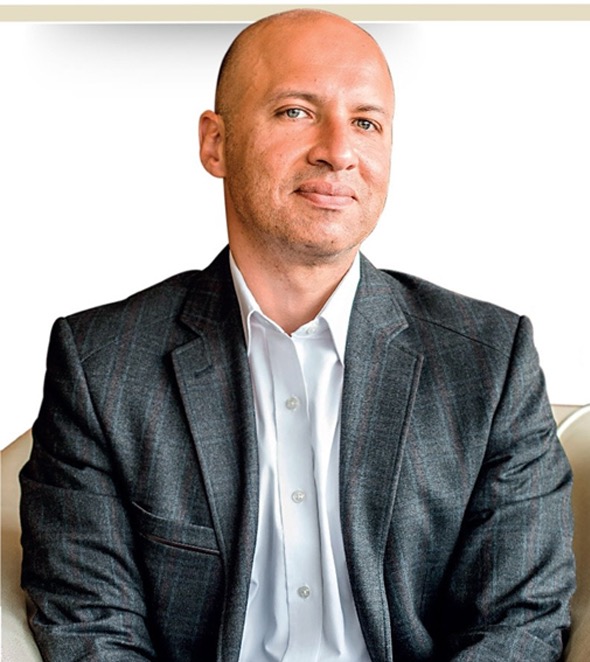
Khaled Farouk
Vice Chairman at The Egyptian Junior Business Association
